


Stock code: 002653.SZ


Youkepan® (Ciprocopan Succinate Tablets)
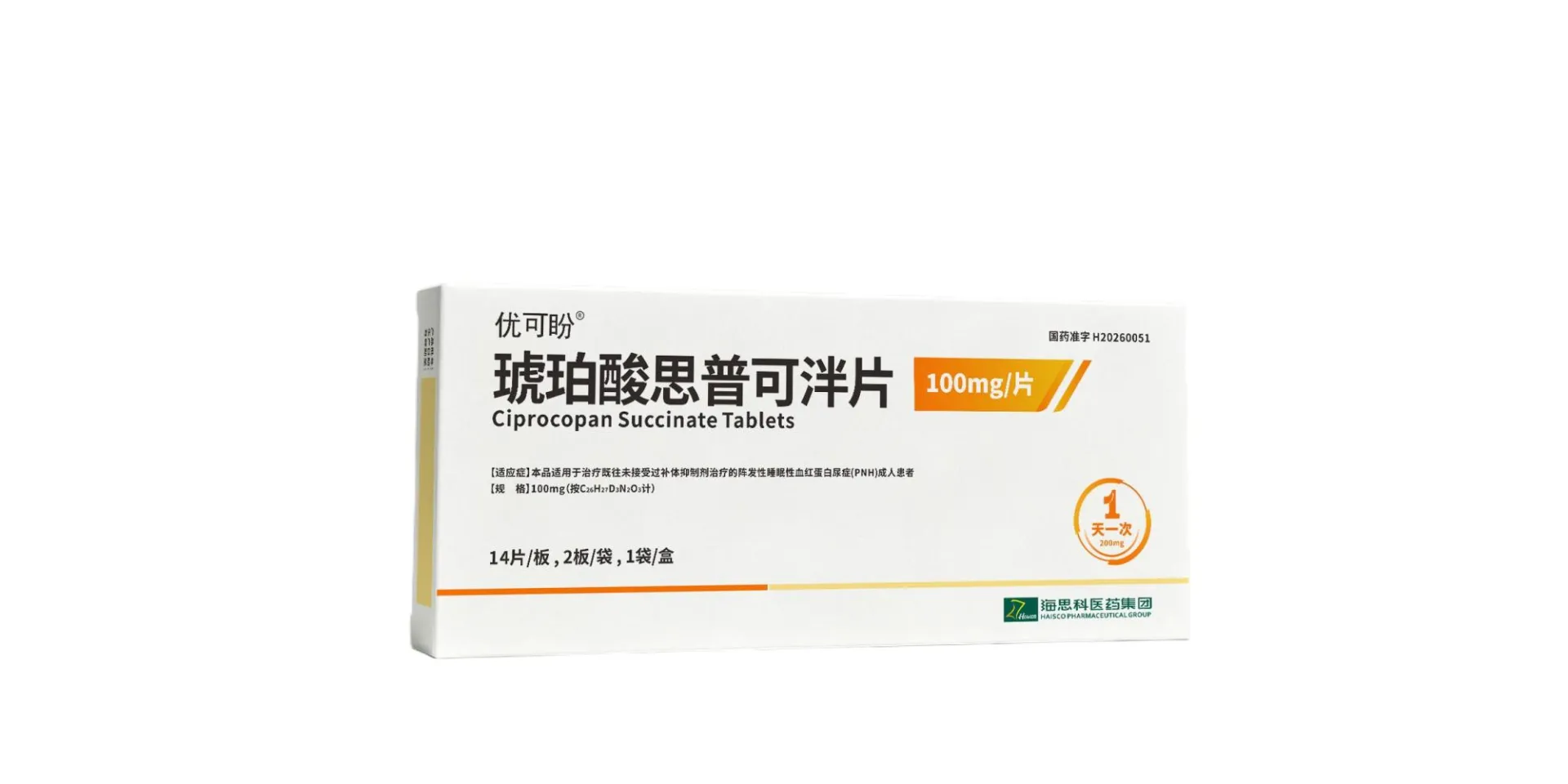
Haisco's independently developed Class 1 innovative drug, Ciprocopan Succinate Tablets—a next-generation complement Factor B inhibitor—was granted early marketing approval on July 21, 2026 through priority review and approval for the treatment of adult patients with paroxysmal nocturnal hemoglobinuria (PNH) who are complement inhibitor-naïve.
1. Red Blood Cell Disease (Anemia) Group, Hematology Branch, Chinese Medical Association. Chinese guidelines for the diagnosis and treatment of paroxysmal nocturnal hemoglobinuria (2024 edition) [J]. Chinese Journal of Hematology, 2024, 45(08): 727-737.
2. Hematology Branch of Zhejiang Medical Association, Zhejiang PNH Working Group. Zhejiang expert consensus on complement inhibitor therapy for paroxysmal nocturnal hemoglobinuria (2025 edition) [J]. Zhejiang Medical Journal, 2025, 47(6): 561-565, 570.
3. http://www.onkopedia-guidelines.info/en/onkopedia/guidelines/paroxysmal-nocturnal-hemoglobinuria-pnh/@guideline/html/index.html
4. Internal Data
Download prescribing information



Comprehensive Efficacy Upgrade
Better safety profile
Once-Daily Oral Administration
Reduced Risk of Breakthrough Hemolysis
When was Ciprocopan approved?
It was approved on July 21, 2026.
Is Ciprocopan an innovative drug?
It is a national Class 1 innovative drug.
What is the indication of Ciprocopan?
It is indicated for the treatment of adult patients with paroxysmal nocturnal hemoglobinuria (PNH) who are complement inhibitor-naïve.
What is the pharmacological action of Ciprocopan?
It is a selective small-molecule inhibitor of complement Factor B (FB).
Which complement activation pathway does complement Factor B primarily participate in?
It is the alternative pathway.
Which type of PNH is Ciprocopan indicated for?
It is indicated for classic PNH.
What are the main mechanistic advantages of targeting complement Factor B?
It simultaneously controls intravascular hemolysis and extravascular hemolysis.
What is the recommended dose of Ciprocopan?
It is 200 mg once daily.
How should Ciprocopan be taken?
It may be taken with or without food.
In the Phase III 301 study, what was the target achievement rate of Ciprocopan compared with the control group?
59.5%.
What is the metabolic pathway of Ciprocopan?
Fecal excretion is the primary route of elimination (72.2±4.27%), and renal excretion via urine is the secondary route (21.7±2.61%).
What modifications were made to the original drug iptacopan to obtain Ciprocopan?
They include three-membered ring modification and deuteration.
What improvements does Ciprocopan have compared with iptacopan?
Permeability is enhanced with consequent improvement in oral bioavailability.
In the Phase III 302 study, what was the target achievement rate of Ciprocopan compared with the control group?
52.8%.
What are the advantages of Ciprocopan compared with currently marketed competing drugs?
Oral, once daily; no dose adjustment required for patients with mild, moderate, or severe hepatic insufficiency; no reproductive toxicity.



